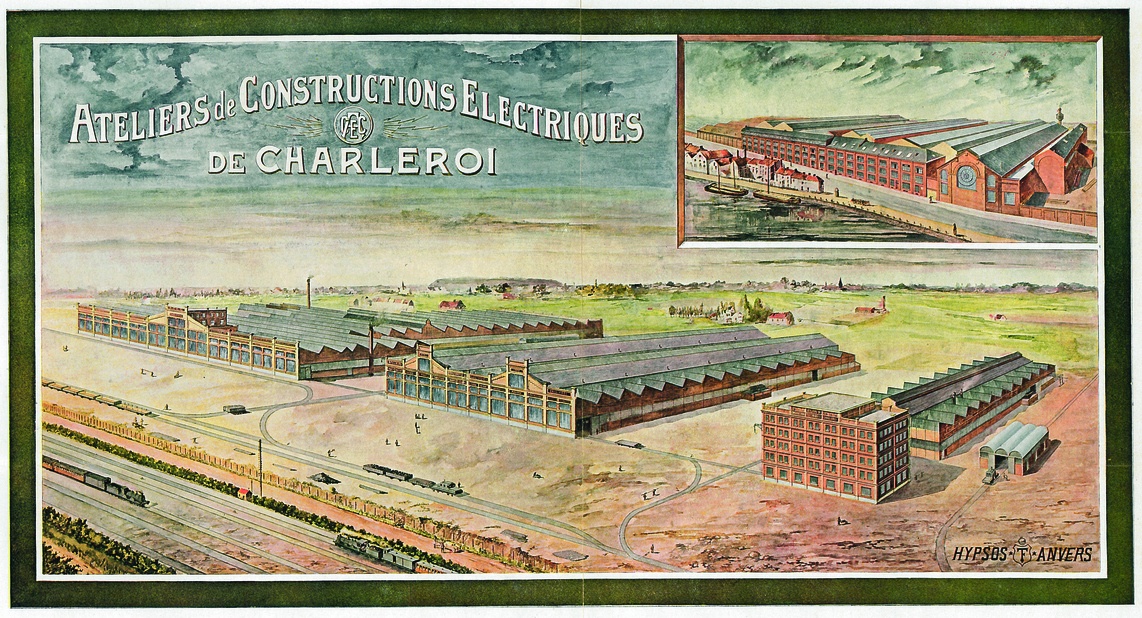
The Ateliers de constructions électriques de Charleroi, better known by the acronym ACEC, left their mark on the history of Belgian electricity for almost a century. The original company was founded by Julien Dulait in Marcinelle, and it took on its new name in 1904.
An internationally renowned company
ACEC became a key player in the electromechanics industry, both in Belgium and around the world. After the Second World War, the company produced railway traction motors, power plant turbines, household appliances and automated industrial machines as well as military and aerospace equipment. People used to say that ACEC made everything “from coffee grinders to nuclear power-station turbo-alternators.” At the height of its success, the company employed more than 20,000 people at its 23 factories in Belgium and abroad. Its name is synonymous with the innovation of its engineers and the technical know-how of its workers.
The crisis years
Starting in the late 1960s, the electrical construction industry began to restructure. In 1970, the American company Westinghouse became the major shareholder and reorganised the company. It passed the baton on to the Société Générale de Belgique in 1985, which focused on specific areas deemed to be strategic (telecoms, aerospace, electronics), largely dependent on public contracts. As the Belgian government moved to cut spending, the company lost a number of key contracts relating to transport, electricity production, telecoms and even military equipment. Restructuring and austerity measures followed one after the other. Strikes and staff sit-ins reflected the reactions to these restructuring measures and layoffs: between 1975 and 1987, the workforce fell from 17,000 to 6,750 employees.
The end of an era
The company was dismantled in 1988-1989. Activities were split up and divided between other companies, such as Alstom for transport and energy, and Alcatel (which went on to become Thales Alenia Space) for telecoms, space and defence. Expertise relating to control systems for industry and nuclear was taken over by Cegelec. The acronym “ACEC” disappeared in 1992.
An industrial heritage
Buildings in Marcinelle and Mont-sur-Marchienne remain from this industrial and human adventure, and electricity cables and aerospace equipment are still produced there. Written, photographic and film archives preserving the memories of the company and its workers have been collected by Archacec and organised by the not-for-profit organisation Post-ACEC. Maintained at the Bois du Cazier site, they keep the memories of this industrial success story alive.
⛏️ Partez sur les pas des mineurs !
Visites guidées au Bois du Cazier les derniers dimanches du mois • du 28/06 au 25/10 • de 14h à 16h30 • 11€ → Plus d'infos ici !
